
Designing for Durability and Low Maintenance in Timber Projects
Key take aways
Timber gets crossed off shortlists for one reason more than any other, and it doesn’t matter whether the project is a family deck or a five-storey façade: the assumption that it needs constant upkeep. Next to concrete or aluminium, that’s a fair worry to raise. But it treats maintenance as something baked into the material, when it’s actually closer to a dial you can turn up or down depending on how the project is designed.
What determines how much maintenance a timber project needs isn’t the timber alone. It comes down to four things working together:
- Species durability: how naturally resistant the timber is to decay, termites and borers.
- Detailing: how the structure is built to manage moisture, drainage and airflow.
- Coating: the finish system applied, and how often it needs attention.
- Climate match: how well the species, detailing and coating suit the specific site’s exposure.
Get one of these wrong and the other three can only compensate so far. That’s also why “timber needs oiling every year” and “timber can go decades without attention” are both true statements, just about different systems.
This guide walks through each of those levers, and how to combine them so timber holds up, on a house, a public building, or anything in between, without turning into an ongoing chore.
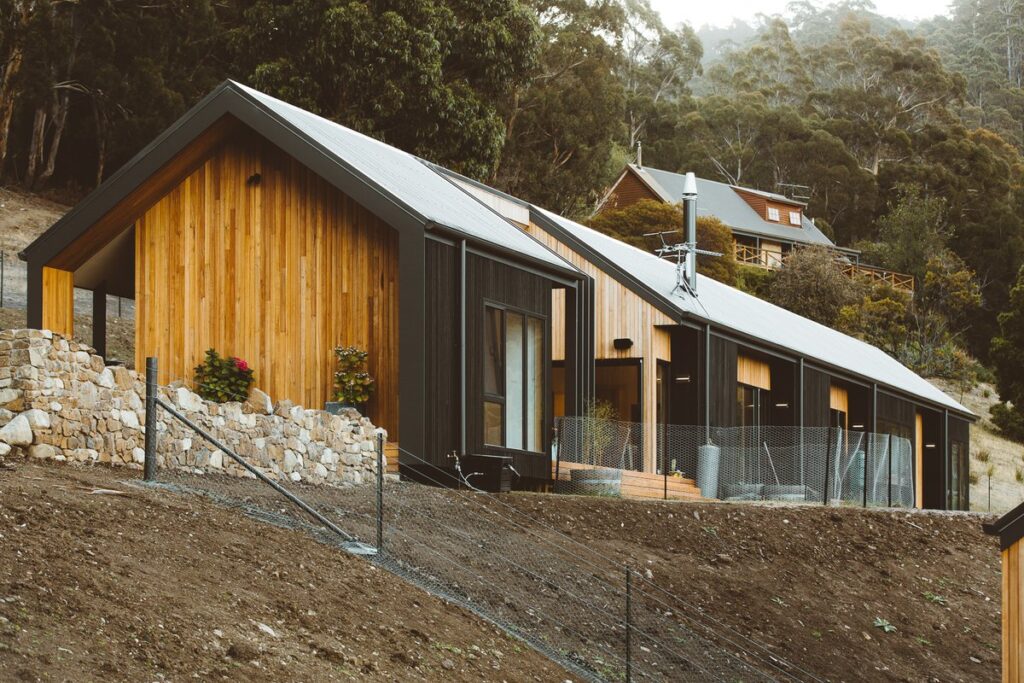
Durability class is the starting point, not the answer
Timber durability class, set out in AS 5604:2022, rates how a species’ heartwood resists fungal decay, termite attack and borer damage without preservative treatment. It’s the first filter in any specification, but a few things about it are easy to miss:
- Class 1 species (Spotted Gum, Ironbark, Blackbutt) are rated for 40-plus years of service life above ground in their natural state, with no preservative treatment required.
- Durability class is rated separately above ground and in-ground. Spotted Gum, for example, is Class 1 above ground but only Class 2 in-ground, a distinction that matters if you’re specifying the same species for decking boards and the posts underneath them.
- Class alone doesn’t guarantee the outcome. A Class 1 species installed flat against a slab with nowhere for water to drain can show decay within a decade, while a well-detailed Class 2 species (good falls, proper ventilation, a maintained finish) can outlast it.
Treat durability class as the opening move, not the whole conversation. Species selection first, then detailing, then finish, then a maintenance plan. Each layer supports the one before it. (For the full breakdown of what each class means and how species compare, see our Timber Durability Classes Guide
The detailing that actually cuts maintenance callouts
Two identical Spotted Gum decks, same batch, same coating. One’s still tight after a decade. The other’s cupped within three years. The difference isn’t the timber. It’s what happened at the drawing stage before either board was ever cut.
The details that matter most:
- Ventilated rainscreen cavity: a continuous 15–20mm air gap between the cladding and the structural wall lets bulk water drain away at the base while airflow dries the back face of the boards, preventing the uneven moisture that drives cupping and warping.
- Sloped horizontal surfaces: beam ends and other horizontal surfaces cut to at least a 15-degree slope, so water sheds instead of sitting.
- Stand-off brackets: posts and columns set on stainless steel stand-off brackets rather than resting directly on concrete or in soil.
- Sealed end grain: end grain sealed before installation, since it’s the most porous part of any board and left open it draws moisture up into the timber like a wick.
- Concealed fixings: systems like Trendplank’s remove the surface depressions where water pools around exposed fastener heads.
Match your maintenance plan to the climate
The same species can behave completely differently depending on where it’s built. A Spotted Gum deck in Cairns is fighting sustained humidity and termite pressure; the same deck in Hobart is dealing with sharp seasonal moisture swings and aggressive UV on a north-facing wall. Planning for maintenance means planning for the specific climate zone, not the species in isolation.
| Climate zone | Primary challenge | Fixing spec | Typical recoat interval |
|---|---|---|---|
| Coastal | Salt spray, humidity, UV | 316 stainless within 10km of surf | 12–18 months |
| Tropical | Sustained humidity, termites | 316 stainless | 12–18 months |
| Temperate | Seasonal moisture swing | Galvanised; stainless near coast | 12–24 months |
| Arid / inland | Low humidity, extreme UV, rapid drying | Galvanised | 12 months (high UV) |
A full detail on species and detailing by zone is in our How Climate Affects Timber Guide.

Choosing a coating: How much maintenance do you really want?
Every coating system is really a trade between upfront cost, appearance on day one, and how often someone needs to get back up there with a brush.
| System | Look on day one | Maintenance | Best for |
|---|---|---|---|
| Clear penetrating oil (Cutek CD50) | Natural timber tone, weathers over time | Recoat roughly every 1–2 years, sooner on full exposure | Cost-conscious projects, full weather exposure |
| Pre-grey stain (WOCA Grey) | Instant, consistent weathered grey | Higher — stain needs reapplication | Mixed-exposure buildings where consistency matters |
| Controlled erosion stain (Grimes & Sons) | Accelerated weathered look that settles naturally | Moderate | Projects wanting an authentic aged look from day one |
| Silicate-based (SiOO:X) | Natural or pigmented silver-grey | Lowest — recoat every 5–6 years, can run 10–15 years before it’s needed | Long-term builds, residential or commercial, where maintenance access is limited |
Two things are worth knowing before you commit to a system:
- SiOO:X isn’t recommended for decking, since foot traffic wears the coating away faster than the finish is designed to handle.
- Any clear finish will fade faster than a pigmented one under Australia’s UV load. Pigment is what gives a coating its lasting colour protection, not the base product underneath it.
Weathering is a design choice, not a defect
Left with a clear or no finish, most external timber will shift from its natural colour to a soft silver-grey over time, as UV breaks down surface lignin and rain washes out tannins. That process is completely normal and shouldn’t be confused with fungal decay, which is a moisture problem caused by poor detailing or installation, not the timber ageing as intended.
Once you’re designing around it rather than fighting it, weathered timber becomes one of the lowest-maintenance finishes available, because you’re largely letting the material do what it does naturally. It’s a common specification for:
- Boardwalks
- External timber cladding
- Timber screening
- Decking
It can also be accelerated or made consistent with the coating systems above, if an even, immediate look matters more than the natural, gradual version.
Using timber in sheltered, low-exposure zones
Areas shielded from direct weather (eaves, soffits, alfresco ceilings, covered walkways) carry almost none of the maintenance burden of fully exposed timber, simply because the elements driving wear (UV, rain, moisture cycling) barely reach them. That makes these zones a good entry point for timber on almost any build, a home renovation as much as a commercial fit-out, where the brief is aesthetic impact without an ongoing service commitment.
Products that suit this application:
- Satinplank timber lining: eaves, alfresco ceilings, feature walls, soffit lining.
- Trendplank timber cladding: concealed-fix, suited to both internal and external use.
- Timber battens: screening and ceiling lining battens.

Thermally modified timber for the hardest-to-reach jobs
Vacoa and Malvec go through a heat treatment process that permanently alters the timber’s cell structure, reducing how much moisture it absorbs and releases. In practice, that means:
- Less cupping and less checking than more reactive species see in the same conditions.
- A longer stretch between maintenance visits, since the timber moves less as humidity changes.
- The best fit for jobs where access is the real cost driver: a high-rise façade, a difficult-to-scaffold elevation, a holiday house you’re not visiting every month, or any project where nobody wants a maintenance callout to mean more than a ladder and an afternoon.
Getting compliance right also gets durability right
Compliance requirements for bushfire and coastal zones double as durability guidance, since both are really asking the same question: will this material and fixing survive the conditions it’s being installed into.
- Bushfire zones: timber selection for cladding is governed by AS 3959, and density is the deciding factor rather than durability class. Blackbutt, Ironbark and Spotted Gum are among the seven bushfire-resisting timbers listed in the standard, and BAL–29 requires a minimum density of 750kg/m³.
- Coastal zones: the NCC’s coastal corrosion provisions call for 316-grade stainless steel on fixings within 10km of breaking surf. Standard galvanised fixings corrode quickly in salt air, and the resulting rust stains permanently mark the timber around them.
- Mortlock’s standard hardware: our standard fixings handle the great majority of coastal sites without needing to move up a grade. In our experience, sites facing direct salt spray have moved up to a 316 stainless screw in the past, given the environment is extreme enough. If you’re not sure which end of that range your site sits in, it’s worth raising with our team.
Proof it holds up
These systems aren’t theoretical. They’re already holding up across homes and commercial builds around the country.
| Project | Species / system | Why it was specified |
|---|---|---|
| Freshwater Café | Pre-oiled Ironbark, clear oil finish, installed 2016 | Left to weather naturally; close to a decade on, it’s held its form and developed the silver-grey patina the approach is designed to deliver |
| Kingswood Residence | Blackbutt across battens, cladding and decking | Unified the whole exterior in one durable, bushfire-rated species |
| Dawesville House | Spotted Gum | Suited a coastal WA setting, balancing resilience with warmth |
| Barwon Heads Residence | Blackbutt | Chosen specifically to handle sustained coastal salt exposure |
FAQS
Not inherently. Maintenance load depends on species durability class, installation detailing, coating choice and climate expression. A well-detailed, correctly coated Class 1 species in a matched climate can go years between maintenance visits.
It depends on the system and where the timber has been installed. Clear penetrating oils typically need reciting every 12-18 months in full exposure to maintain full colour. Silicate-based coatings can run 5-15 years between redcoats. Sheltered, low-exposure applications need attention far less often than either.
Weathered finishes need minimal upkeep once established, since the material is largely doing what it naturally does under UV and rain.
Class 1 species like Spotted Gum, Ironbark and Blackbutt offer the strongest natural resistance to decay, and thermally modified options like Vacoa and Malvec add extra dimensional stability. The right choice depends on climate zone, exposure, accessibility and the coating paired with it.
View our pricing and product guide
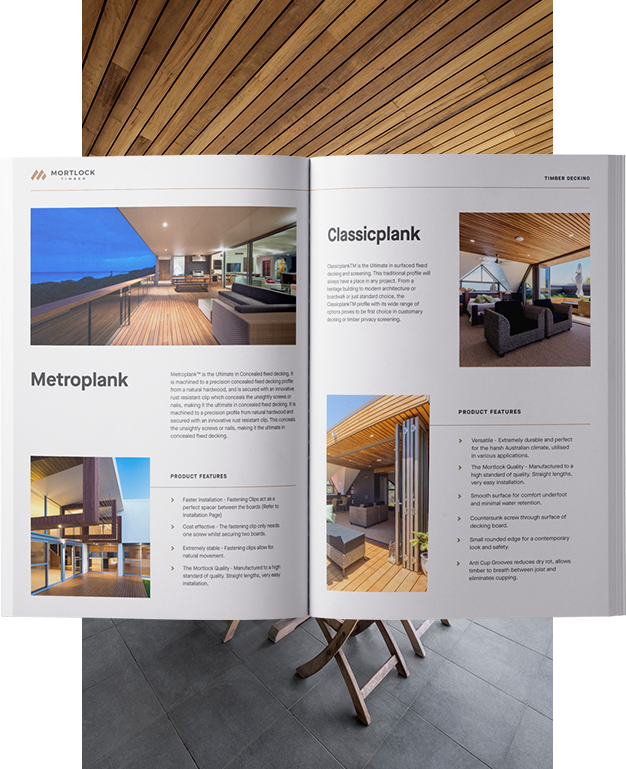
We are committed to bringing you timber products that add value and endure for years to come, even in heavy traffic and harsh weather conditions. We understand the value of efficiency when it comes to installation and keeping hardwood timber costs down. That’s why we’ve spent decades perfecting our designs to make them easier to handle, less wasteful and more efficient to install. This efficiency allows us to offer you premier products that are more cost-effective so that you can experience greater savings on timber wall costs, timber ceiling costs, timber cladding costs and timber decking costs.
Download our Pricing and Product Guide for our complete hardwood timber price list including timber decking prices, timber wall prices, timber ceiling prices and timber cladding prices.