
Shiplap or Trendplank: Which Timber Cladding Profile Suits Your Project?
Key take aways
Most people choosing a timber cladding profile focus on species and finish first, with the joint and shadow line seeming as almost an afterthought. Mortlock Timber understands that it’s worth more attention than that. Two identical boards, in the same timber species and finish, can produce a completely different-looking façade depending on how they meet at each edge.
Both Shiplap and Trendplank are concealed-fixed, tongue-and-groove cladding profiles. Each are designed to let timber move naturally but where they part is within the size of the join or shadowline. It’s this difference that makes a significant statement to the appearance of a project once it’s repeated across an entire façade.
What is Shiplap?
Shiplap has been around long enough that most architects, builders and homeowners can picture it without being shown a sample. It’s a concealed-fixed board with a 10.5mm shadow line – a wider gap than most alternatives, which gives a façade a strong, more graphic rhythm. Each joint is visible from a distance, and on a full wall, this adds up to a pattern that becomes part of the building’s character.
Shiplap is not a Mortlock product in the sense that Trendplank is – Shiplap is a traditional profile that we supply, not something we’ve engineered over years of working with architectural timber. That’s part of why it’s still specified, it’s a known quantity.

What is Trendplank?
Trendplank is Mortlock’s own concealed-fixed cladding system, engineered specifically to manage the way timber expands, contracts and settles over time but with a noticeably quieter join. Its nominal shadow line sits around 7mm, roughly a third narrower than traditional Shiplap profiles, so the timbers grain and colour do more of the talking than the line between boards.
The other real difference is flexibility. Shiplap comes in one fixed size. Trendplank is available across a range of board widths that can be mixed on the same façade, so a designer can vary the rhythm across a wall rather than accepting a single repeating pattern. That’s the sort of detail that tends to matter more on architectural-lead projects where the cladding is doing some of the work, not just covering the wall.

Shiplap & Trendplank at a glance
| Shiplap | Trendplank | |
|---|---|---|
| Shadow line | Nominal 10.5mm | Nominal 7mm |
| Visual character | Broader, stronger, more pronounced | Finer, quieter, more refined |
| Board sizes | 122 × 19mm | 40, 50, 70 or 120mm cover width, in 19, 30 or 40mm thickness — availability varies by species |
| Profile range | Single fixed profile | Multiple widths, mixable on one façade |
| Profile type | Traditional, widely used profile | Mortlock’s own concealed-fixed system |
| Best suited to | Projects where a strong, repeated joint adds character | Contemporary architecture and customised façade rhythms |

So which one do you actually pick?
It depends! Neither is the “better” cladding in absolute terms. A costal or heritage-leaning build often suits Shiplap’s bolder shadow line whereas a contemporary architect-designed home more often reaches for Trendplank. They’re different tools for different outcomes, but if you are still asking yourself the question as to which system would best fit your project then;
Shiplap may be the better fit if you want:
- A pronounced, 10.5mm shadow line
- Restoration of older or heritage buildings
- A single fixed size of 122 x 19
- A traditional timber cladding profile
Trendplank may be the better fit if you want:
- A refined, 7mm shadow line
- Subtle, contemporary detailing
- Custom profiles and widths
- Greater emphasis on the timber surface, rather than the join.
A note on shadow lines and rhythm
The difference between a 7mm and 10.5mm shadow line sounds small on paper, but repeated across dozens of boards on a full façade, that difference compounds into a genuinely different visual language. It’s the same principle as stripe width on fabric: a narrow tight rhythm reads quiet and refined, while a broader, bolder rhythm reads as a statement in its own right. Neither approach is right or wrong; it’s a design decision that should match the character you want the project to have.
FAQS
The key difference is the shadow line. Shiplap has a broader, nominal 10.5mm shadow line, while Trendplank uses a finer, nominal 7mm line. Trendplank is also available in a range of mixable widths, while shiplap is a single 122x19mm profile.
No. While both are concealed-fixed, tongue-and-groove cladding profiles, Trendplank is Mortlock Timber’s own proprietary system, engineered as a distinct alternative to traditional profiles like Shiplap.
Trendplank’s finer 7mm shadow line and mixable board widths tend to suite contemporary, detail-focused architecture, where a quieter joint keeps the focus on the timber surface. Shiplap’s broader, more pronounced joint often suits project where a stronger, repeated pattern is part of the building’s character.
Yes – Get in touch with the Mortlock Timber team to request samples or discuss which profile suits your projects design intent, timber species and budget.
View our pricing and product guide
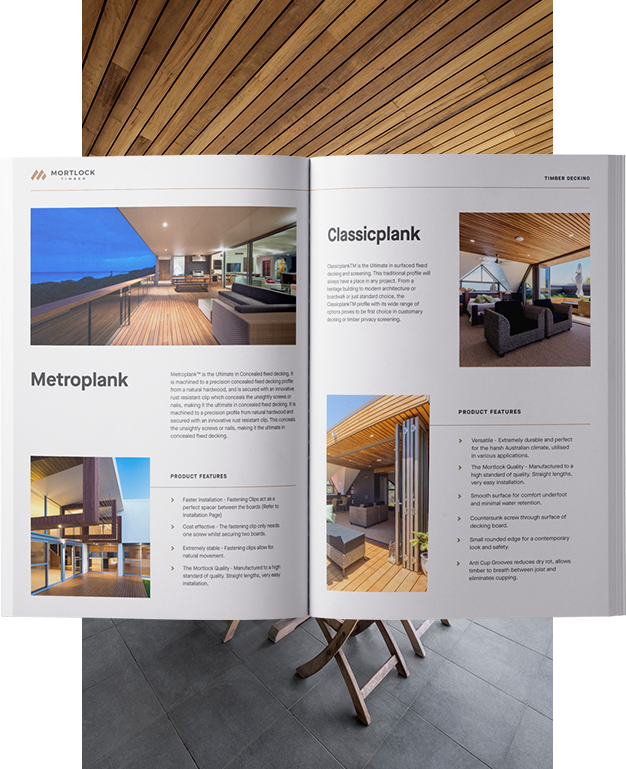
We are committed to bringing you timber products that add value and endure for years to come, even in heavy traffic and harsh weather conditions. We understand the value of efficiency when it comes to installation and keeping hardwood timber costs down. That’s why we’ve spent decades perfecting our designs to make them easier to handle, less wasteful and more efficient to install. This efficiency allows us to offer you premier products that are more cost-effective so that you can experience greater savings on timber wall costs, timber ceiling costs, timber cladding costs and timber decking costs.
Download our Pricing and Product Guide for our complete hardwood timber price list including timber decking prices, timber wall prices, timber ceiling prices and timber cladding prices.