
How Climate Affects Timber Across Australian Conditions
Key take aways
Picture two Spotted Gum decks built in the same month from the same batch of timber, both carrying a Class 1 durability rating under AS 5604 and a Janka hardness of 11.0 kN. One goes to Cairns, the other to Hobart. Five years later, you’d swear they were different materials entirely.
The Cairns deck will have battled sustained humidity above 70%, aggressive termite pressure, and monsoonal rain that keeps the timber’s moisture content hovering near the threshold for fungal decay. The Hobart deck will have contended with dry winters, sharp seasonal moisture swings, and relentless UV on its north-facing aspect, silvering the surface months earlier than the owner expected.
Same timber, completely different performance. This is the reality of how climate affects timber in Australia, and it’s why species selection alone will never be enough. The continent spans eight NCC climate zones, from tropical monsoon to alpine cold, and specifying timber that will actually perform in your specific location, orientation, and exposure means understanding what each climate does to wood at a cellular level.
Why Timber Moves
Timber is hygroscopic, which means it continuously absorbs and releases moisture to reach equilibrium with the air around it. This equilibrium moisture content (EMC) is the single most important variable in predicting how timber will behave on any given project.
The numbers shift dramatically across the country. In humid coastal and tropical zones, exterior timber typically stabilises at an EMC of 12–17%, while dry inland regions can pull that figure down to 8–12%. Air-conditioned interiors across any zone sit lower again, around 7–9%. (These ranges are documented in AS/NZS 1080.1, which governs timber moisture content testing in Australia.) Those gaps matter more than most people realise. Timber that ships from a coastal mill at 12–14% moisture content and arrives at a site in Alice Springs will lose moisture fast, shrinking as it acclimatises. The result shows up as checking, cupping, and gaps opening between boards, sometimes within weeks of installation.
The movement isn’t random either. Timber shrinks and swells across the grain, with tangential movement roughly double the radial rate and longitudinal change being negligible. This anisotropic behaviour is what drives cupping in decking boards and joint gaps in timber cladding profiles, and understanding it is step one in getting the detailing right.
What the Australian Climate Does to Timber

Humidity and Rainfall
Sustained moisture is the number-one killer. When a timber board’s moisture content stays above 20% long enough, fungal spores germinate and start consuming the wood’s structural polymers. In tropical zones like Darwin and Cairns, monsoonal rain and year-round humidity make this a persistent threat, and ventilated rainscreen cavities, adequate falls, and end-grain sealing aren’t nice-to-haves up there. They’re survival basics.
UV Radiation
Australia cops some of the most intense UV radiation on earth, and timber wears every hour of it. UV energy targets lignin, the natural binder that holds wood fibres together, and as it degrades, the surface loses colour and structural integrity before transitioning to the familiar silver-grey patina.
Here’s what catches people out: this happens regardless of species or timber durability class. A Class 1 Ironbark will silver just as fast as a Class 2 Jarrah without a UV-protective coating, because durability class measures resistance to biological decay and has nothing to say about UV. Penetrating oils with pigment offer the best balance of protection and breathability for exterior applications.
Coastal Salt
Most Australians live within 50 km of the coast, so salt exposure features on a huge proportion of projects. Salt is hygroscopic, drawing moisture into the timber, keeping it damp longer, and feeding the conditions that accelerate decay. Over time, this sustained moisture retention can compound the surface weathering that UV has already started.
The fixings cop it too. Within 10 km of breaking surf, 316-grade stainless steel is the minimum standard for any weather-exposed fastener. Standard galvanised fixings corrode fast in salt air, and the resulting iron stain permanently degrades the surrounding timber.
Termites
Termite risk in Australia is highest in the tropical north, particularly above the Tropic of Capricorn, where warm, humid conditions support year-round activity and termite species such as Mastotermes darwiniensis. In these regions, Class 1 timbers like Ironbark and Spotted Gum are typically specified, alongside termite management systems under AS 3660 and careful detailing, as no timber is completely immune under sustained exposure. Moderate risk extends across most of the eastern seaboard, Perth, and Brisbane, while only Tasmania sits at negligible risk.
All four of the species most commonly specified for exterior architectural timber in Australia (Spotted Gum, Ironbark, Blackbutt, and Jarrah) are rated termite resistant in their heartwood under AS 3660. But that applies to heartwood only, and sapwood of every species remains vulnerable, which is why specifying the right grade matters as much as specifying the right species.
Bushfire Zones
In bushfire-prone areas, timber selection for cladding is governed by AS 3959. The key variables are species and density, not durability class. Seven bushfire-resisting timbers are listed in the standard, including Spotted Gum, Ironbark, and Blackbutt. For BAL–12.5 and BAL–19, cladding timber needs a density of 750 kg/m³ or more at 12% moisture content. At BAL–29, it must be one of the listed bushfire-resisting species, regardless of density.
Jarrah, despite its strong durability credentials, is only rated to BAL–12.5 and BAL–19. No Mortlock Timber product is rated for BAL–40 or BAL–FZ, which require non-combustible materials.
Timber Performance by Climate Zone
The map of Australia is really a map of different demands for timber. Here’s how those demands break down.
| Factor | Coastal | Tropical | Temperate | Arid / Inland |
| Primary challenge | Salt spray, humidity, UV | Sustained humidity, termites | Seasonal moisture variation | Low humidity, extreme UV, temp swings |
| Outdoor EMC | 12–17% | 12–17% | 10–14% | 9–14% |
| Min. durability class | Class 1 preferred | Class 1 essential | Class 1 or 2 | Class 2 acceptable |
| Best species picks | Spotted Gum, Blackbutt | Ironbark, Spotted Gum | Blackbutt, Jarrah, Spotted Gum | Spotted Gum, Ironbark |
| Fixing specification | 316 stainless (<10 km surf) | 316 stainless | Galvanised; stainless near the coast | Galvanised |
| Recoat frequency | 12–18 months | 12–18 months | 12–24 months | 12 months (high UV) |
| Key maintenance risk | UV coating degradation, salt ingress | Fungal decay at >20% MC | South-facing moisture retention | Checking/splitting from rapid MC loss |
(EMC and durability data sourced from AS 5604:2022 and AS/NZS 1080.1. Fixing requirements per NCC coastal corrosion provisions.)
Coastal: Perth, Sydney, the Eastern Seaboard
Perth’s afternoon sea breeze drives salt-laden air deep into building envelopes, and Sydney’s eastern suburbs cop direct ocean spray on exposed façades. In both cases, performance in coastal environments is primarily driven by durability class, detailing, and maintenance. Spotted Gum is a strong choice for coastal timber cladding because of its Class 1 durability rating and density, and concealed fixing systems help by eliminating surface depressions where salt water pools and accelerates decay. Pacific Teak is another well-suited specification in these zones, a Class 2 hardwood with tight grain and high natural oil content that performs reliably in humid marine conditions, including projects like the Dawson Residence.
Tropical: Darwin, Cairns, Brisbane
These regions present the highest combined decay and termite hazard in the country, and Class 1 species aren’t optional up here. Ironbark holds a distinct advantage because it achieves Class 1 durability both above ground and in-ground under AS 5604, making it suitable for structural posts and bearers as well as cladding and timber decking. Malvec offers a thermally modified alternative where dimensional stability is as much a concern as decay resistance. Heated to 230°C to achieve Class 1–2 durability with a 50+ year projected service life, it holds its shape well under the constant moisture cycling these zones deliver. Climate research from the CSIRO/FWPA TimberLife project (Wang et al., 2012) projects that decay rates could increase by approximately 10% in Brisbane and Sydney by 2080, which reinforces the value of specifying conservatively in these zones today.
Temperate: Melbourne, Hobart, Adelaide
Temperate zones offer the most forgiving conditions for timber, but they’re not without traps. Seasonal humidity variation drives cyclical swelling and shrinkage that stresses joints and fixings over years rather than months, and south-facing walls dry slowly, making them more prone to mould and surface decay. Both Class 1 and Class 2 species perform well here with good detailing. Jarrah, with its natural marine borer resistance and rich, warm colour, remains a popular specification for decking and screening in southern states. Pacific Teak suits projects calling for a warmer, golden-brown palette with strong weather resistance, and Vacoa, a thermally modified Scandinavian pine, offers a cost-effective option for cladding and ceiling lining where dimensional stability is a priority.
Arid Inland: Alice Springs, Kalgoorlie, Inland NSW
The risk here isn’t decay but the opposite problem entirely. Extremely low humidity strips moisture from timber fast, causing aggressive shrinkage, checking, and splitting. Timber shipped from a coastal supplier at 12–14% moisture content may arrive too wet for inland conditions, and two to four weeks of on-site acclimatisation before installation is standard practice under Australian Standards.
Intense UV demands attention, too. Pigmented coatings are strongly recommended over clear finishes, and recoating intervals tend to be shorter than in coastal areas. Thermally modified timber products come into their own in these conditions. Vacoa, a thermally modified Scandinavian pine, and Malvec, heated to 230°C to achieve Class 1–2 durability with a projected service life of 50+ years, both have cell-wall chemistry permanently altered to reduce moisture absorption.
In practice, that means less checking, less splitting, and more consistent board alignment than reactive species can deliver in the same arid conditions.
Choosing the Right Species
The timber durability class system under AS 5604 is the starting point for species selection, but it doesn’t tell you everything you need to know. A Class 1 rating means the heartwood resists biological decay for 40+ years above ground, but it says nothing about UV resistance, dimensional stability, workability, or bushfire compliance.
Here’s how the species we work with most frequently compare:
| Species | Janka (kN) | Density (kg/m³) | Above-Ground Class | BAL Rating | Best Suited For |
| Spotted Gum | 11.0 | 990 | Class 1 | BAL–29 | Coastal cladding, decking, and bushfire zones |
| Ironbark | 14.0 | 1,090 (Red Ironbark) | Class 1 (incl. in-ground) | BAL–29 | Tropical, structural, maximum exposure |
| Blackbutt | 9.1 | 900 | Class 1 | BAL–29 | Temperate zones are not susceptible to the lyctid borer |
| Jarrah | 8.5 | 820 | Class 2 | BAL–12.5/19 | Temperate decking, marine borer resistance |
| Pacific Teak | — | 750 | Class 2 | BAL–12.5/19 | Warm aesthetic, moderate exposure |
| Vacoa | — | 404 | Class 2 | Non-BAL compliant | Stable cladding and ceilings in variable climates |
Durability data from AS 5604:2022. BAL ratings from AS 3959:2018. Species specifications verified against Mortlock Timber’s published data.
Dimensional Stability Under Stress
Not all hardwoods behave the same under stress. In climates with high humidity, salt exposure, or extreme drying conditions, dimensional stability becomes as important as durability class. Two species can share the same Class 1 rating and still perform very differently when it comes to moisture-driven movement, and it’s this movement that causes cupping, checking, board misalignment, and premature coating failure.
Materials such as thermally modified timber and more stable hardwood species like Pacific Teak are selected specifically to reduce moisture-driven movement. Thermal modification permanently alters the timber’s cell structure, lowering its equilibrium moisture content and reducing its capacity to absorb and release water. The result is less cupping and checking, more consistent board alignment, and reduced stress on fixings and coatings.
In high-exposure environments, coastal façades, tropical decking, north-facing elevations in arid zones, these characteristics can materially extend service life and reduce maintenance frequency when compared to more reactive species. For specifiers working in these conditions, dimensional stability should sit alongside durability class and density as a core selection criterion.
Where Detailing Meets Climate
Even a Class 1 hardwood will fail prematurely if the detailing traps moisture, which is why specifying the right species is only half of the equation and designing for durability is the other.
Ventilated rainscreen cavities are the gold standard for timber cladding in any climate zone. A continuous air gap of 15–20 mm between the cladding and the structural wall lets bulk water drain to the base flashing while convective airflow dries the rear face of the boards, equalising moisture content between the front and back surfaces and dramatically reducing the cupping and warping caused by differential shrinkage.
Horizontal surfaces trap water, so exposed beam ends should be cut with a minimum 15-degree slope to shed rain, and posts and columns should sit on stainless steel stand-off brackets rather than in direct contact with concrete or soil. End-grain is the most porous part of any timber board, and left unsealed, it acts like a wick drawing ground moisture up into the structural core. Coating strategy varies by climate, too. In coastal and tropical zones, penetrating oils with Colourtone pigments need reapplication every 12–18 months to maintain colour and moisture protection, while sheltered temperate locations can stretch that interval to two years. Alternatively, allowing timber to weather naturally to a silver-grey patina eliminates colour-maintenance coats entirely, though stability coats are still recommended every four to five years.
Let’s Talk About Your Project

Choosing the right timber for Australian conditions comes down to matching species, profile, and detailing to your specific climate zone and project requirements, and it’s a conversation we have with architects and builders across the country every day.
At Mortlock Timber, we manufacture and supply architectural timber cladding, timber decking, timber battens, and timber ceiling systems from our facility in Cunderdin, Western Australia, with offices in Perth, Sydney, Melbourne, Adelaide, and Hobart. Every product is pre-coated before nationwide delivery.
If you’re working through species selection or need guidance on detailing for a specific climate zone, get in touch with our team. We’re here to help you bring your vision to life and move forward with confidence.
Call us on 1800 894 400 or request a product pricing guide to get started.
FAQS
Yes, timber swells in humid climates as it absorbs moisture and shrinks in dry climates as it loses moisture. In coastal and tropical zones, exterior timber typically stabilises at 12–17% moisture content, while in arid inland regions it may drop to 8–12%, showcasing how climate affects timber in size.
Not necessarily. A Class 1 species like Spotted Gum performs well across most zones, but the detailing, maintenance schedule, and fixing specification will differ significantly between Darwin and Hobart. Climate-specific specification is always recommended, due to how climate affects timber.
Directly. Coastal and tropical projects with high UV, salt, and humidity exposure typically need recoating every 12–18 months. Sheltered temperate locations can often extend to 24 months. North and west-facing elevations weather faster than south-facing ones in all zones.
No. Durability class (AS 5604) measures resistance to biological decay, not UV weathering. A Class 1 Ironbark deck will silver just as fast as a Class 2 Jarrah without a pigmented UV-protective finish, because UV breaks down lignin regardless of species.
Rapid moisture loss. Timber shipped from a coastal supplier at 12–14% moisture content can dry too quickly in low-humidity inland conditions, causing checking, splitting, and warping. On-site acclimatisation for two to four weeks before installation is standard practice.
Yes. Spotted Gum, Ironbark, and Blackbutt are all rated to BAL–29 under AS 3959 and are available across our Trendplank cladding and decking systems. Mortlock Timber does not offer products rated to BAL–40 or BAL–FZ, which require non-combustible materials.
View our pricing and product guide
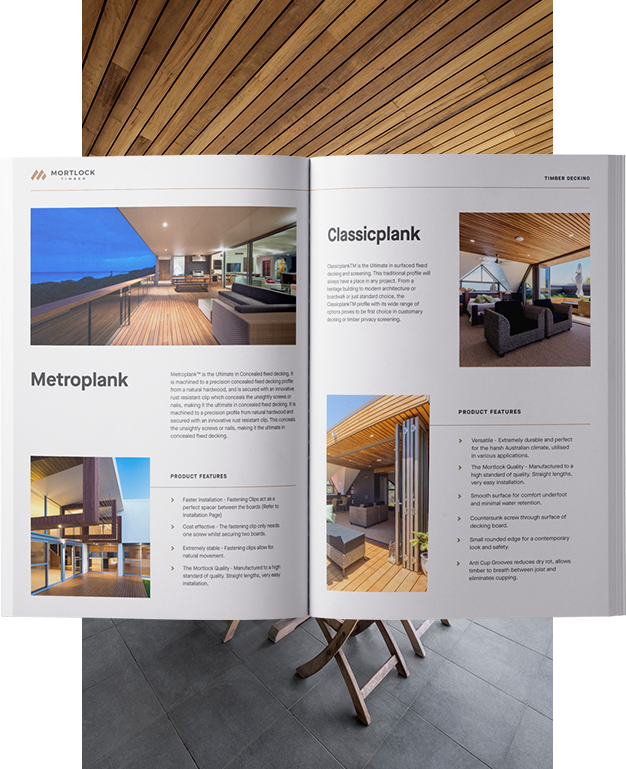
We are committed to bringing you timber products that add value and endure for years to come, even in heavy traffic and harsh weather conditions. We understand the value of efficiency when it comes to installation and keeping hardwood timber costs down. That’s why we’ve spent decades perfecting our designs to make them easier to handle, less wasteful and more efficient to install. This efficiency allows us to offer you premier products that are more cost-effective so that you can experience greater savings on timber wall costs, timber ceiling costs, timber cladding costs and timber decking costs.
Download our Pricing and Product Guide for our complete hardwood timber price list including timber decking prices, timber wall prices, timber ceiling prices and timber cladding prices.