
What Is Weathered Timber? A Guide to Natural Ageing, Finishes and Design Applications
Key take aways
We’ve noticed it in the specification calls, sample requests, and projects coming through our factory. More architects and builders are asking for a weathered timber finish — that soft, silver-grey patina that develops as hardwood ages naturally in the weather. The appetite for timber that looks like it belongs to its environment, rather than fighting it, has grown considerably.
Some clients want it because they love the look. Others want it because the long-term maintenance suits the way they live or operate. Either way, the conversation has moved on from “how do we keep this timber looking new?” to “how do we work with the ageing process rather than against it?”
This guide walks through what weathered timber actually is, how the look is achieved (both naturally and through factory coatings), which species hold up best, and how to plan for it on a real project.
What Is Weathered Timber?
Weathered timber is timber that has changed in colour and texture as a result of long-term exposure to sun, rain, humidity, and air. Left untreated or finished with a clear coating, most species will gradually shift from their natural reds, browns, and golds into a soft silver-grey finish over the years.
It’s the same process you see on old jetties, weatherboard cottages, and fishing huts along the coast. UV breaks down the lignin in the timber’s surface cells, while moisture cycles slowly leach out tannins. The end result is a muted, mineralised appearance that many architects now actively design for.
This look no longer needs to be left entirely to chance or to time. It can be replicated, accelerated, or controlled using factory-applied coatings, meaning a project can be handed over with a weathered finish already in place, or be set up to weather predictably over the years that follow.

How Timber Weathers Naturally
Timber is a hygroscopic material. It continuously absorbs and releases moisture to reach equilibrium with the surrounding air. Combined with UV exposure, this process drives the surface changes we recognise as weathering.
Three things happen at the same time:
- UV radiation breaks down the lignin near the surface, which is what gives timber its warm tones. As lignin degrades, the surface fibres take on a grey appearance.
- Rainwater washes out broken-down lignin and surface tannins, accelerating the colour shift.
- The surface cells contract and expand with moisture cycles, slowly opening up the grain and giving weathered timber its characteristic texture.
How quickly all of this happens depends entirely on the conditions. Coastal and tropical environments — with high UV, salt spray, and humidity — drive faster weathering than sheltered temperate ones. North- and west-facing elevations fade faster than south-facing walls. Areas under eaves or behind shading often barely change at all.
That uneven weathering is one of the most important practical points to understand before specifying a naturally aged finish, and it’s often the detail that shapes which coating system is right for a project.
The Four Ways to Achieve a Weathered Look
There’s no single “weathered timber” product. There’s a spectrum of finishes, each designed to deliver the look in a slightly different way and over a different timeframe.
At Mortlock, we work with four main systems.
1. Natural Weathering with a Clear Oil
This is the simplest approach. Here, timber is finished with a clear penetrating oil, Cutek CD50 is the system we use most often, and then installed in its natural colour. From there, the timber is left to weather over time, transitioning slowly into a silver-grey patina as it ages.
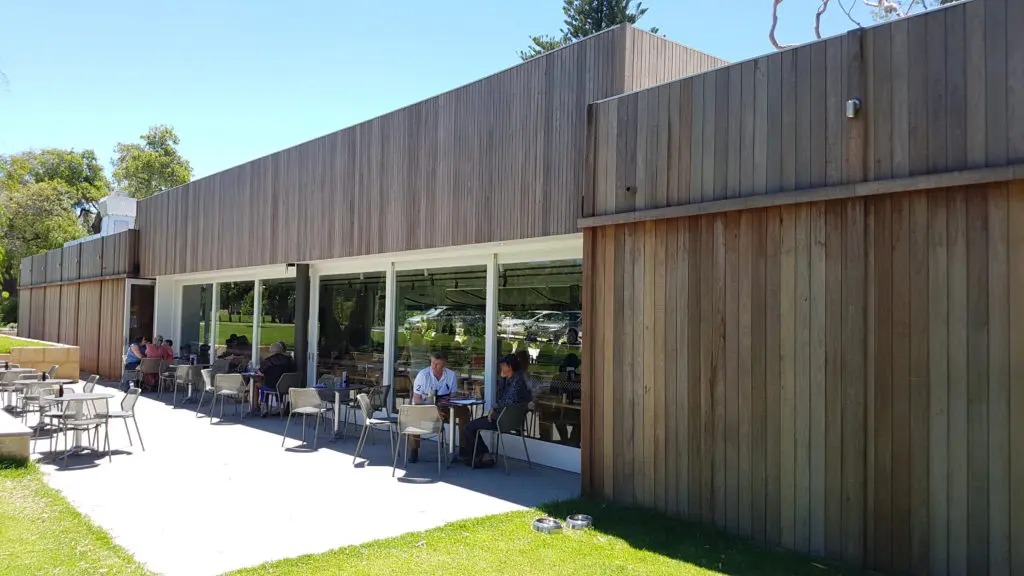
A good case study for this approach is the Freshwater Café, where we supplied pre-oiled Ironbark cladding back in 2016 and let it age naturally over time. Almost a decade on, it’s holding up beautifully and has developed exactly the kind of look this approach is designed to deliver. It’s a useful visual reference for anyone considering a clear-oiled hardwood and wondering what the finish will look like once nature has done its work.
This is the most cost-effective way to achieve the desired finish, and it generally requires the least ongoing maintenance because you’re letting the timber do its own thing. The trade-off is that the result can be gradual and uneven across the building, depending on exposure.
2. Pre-Grey Stain (WOCA Grey)
If you want the weathered look from day one, and you want it to stay consistent across both exposed and sheltered areas of the building, a pre-grey stain is the right choice.
WOCA Grey is the system we use here. It’s a pigmented stain that gives the timber the desired appearance from the moment it’s installed.
The big advantage of this comes down to consistency. With a clear oil system, sheltered areas of cladding age more slowly than unprotected ones, which can lead to an uneven finish across the building. With WOCA Grey, exposed and unexposed areas remain the same grey colour, so the appearance stays consistent regardless of orientation or shading.
It does require more ongoing maintenance than a clear oil system or a silicate coating, because the stain itself will need reapplication over time.
3. Controlled Erosion Stain (Grimes & Sons)
This sits between the pre-grey stain and the natural approach. It’s an accelerated system that’s installed with an artificial weathered appearance, and then transitions to a more authentic look over time.
Architects often choose Grimes & Sons because the result feels more genuine than a flat pre-grey stain. As the cladding ages on the building, the finish softens into a more natural silver-grey patina. Once it has reached the desired look, it can be sealed in with the controlled erosion clear or recoated in the same stain colour.
Maintenance is moderate for this method. While less than the WOCA Grey stain, it’s more than a silicate-based system.
4. Silicate-Based Reactive Coating
This is our lowest-maintenance weathered timber option, and the one that tends to suit projects where long-term performance is the priority.
It’s a silicate-based coating that chemically reacts with the timber and surrounding moisture to accelerate the process. Over time, it produces a mineralised silver-grey surface that replicates aged timber, while sealing the surface for the long run.
There are two versions:
- A clear formulation, applied at the factory. The timber is installed in its natural colour and chemically ages over time.
- A pigmented formulation, where the timber is silvered at the factory, then continues to react with moisture and weather naturally on the building.
It’s a three-coat factory process that involves more labour and a higher coating cost, which makes it the most expensive of the four options. But when it arrives on site, it’s ready to install with no further coats required, and it lasts considerably longer than other systems.
For projects where long-term performance matters and ongoing maintenance is a deal-breaker, this is usually where the conversation lands.
A Quick Comparison of the Four Systems
| System | Look on Day One | Maintenance | Best For |
| Clear oil (Cutek CD50) | Natural timber colour that weathers over time | Low | Cost-conscious projects with full weather exposure |
| Pre-grey stain (WOCA Grey) | Instant weathered grey | Higher (stain reapplication) | Projects with mixed exposure where consistency matters |
| Controlled erosion stain (Grimes & Sons) | Accelerated weathered look that settles into a natural patina | Moderate | Projects wanting an authentic weathered finish from the start |
| Silicate-based reactive coating | Natural or pigmented silver-grey | Lowest | Long-term commercial projects, low-maintenance specifications |
Which Species Suit a Weathered Finish?
Species selection matters more for a weathered finish than for almost any other type of cladding specification. The reason is simple: as timber ages, it’s also moving. If the species isn’t dimensionally stable, cupping, warping, and surface defects can show up.
That’s why, for any weathered application, we recommend stable, durable species like the following:
- Pacific Teak: This offers good dimensional stability and a warm aesthetic that ages gracefully over time.
- Ironbark: One of Australia’s most durable hardwoods, it holds its form well through repeated cycles, as the Freshwater house demonstrates.
- Spotted Gum: This is a reliable all-rounder that weathers to a particularly clean silver-grey.
- Thermally modified timbers (Burnt Ash, Malvec): Heat treatment reduces this timber’s ability to absorb and release moisture. This results in less movement and a more stable weathered result outdoors.
Less stable species — Blackbutt, for example, which has many strengths but is more reactive in some weathered applications — can cup and warp when left to weather externally. They’re not ruled out, but they need to be specified more carefully and usually with a coating system that controls movement.
If you’re weathering timber inside a building or in a sheltered application, species selection isn’t as salient as there’s less moisture-driven movement to worry about. Outside, choose stability first.

Where Weathered Timber Works Best
Weathered finishes can be used across the same range of applications as any other Mortlock timber product. The most common are external timber cladding and façades, where the silver-grey patina becomes a defining architectural feature.
We typically see weathered timber specified for:
- External cladding and façades: Particularly on coastal homes, beach houses, and contemporary residential builds, where the weathered look fits the landscape.
- Boardwalks and decking: Where the soft grey blends naturally with sand, stone, and water.
- Commercial and hospitality projects: Cafés, wineries, and venues where a sense of age and patina is an aesthetic choice.
- Interior feature walls and ceilings: Increasingly, architects are asking for weathered finishes inside as well as outside, often to create continuity between an external façade and an internal feature wall.
We can apply our finishes across Trendplank (our concealed-fix timber cladding), Satinplank (interior wall and ceiling lining), Proplank (click-in batten system), and our screening and battens range. That gives architects the ability to take a weathered look across the whole building envelope, inside and out, with the same coating system holding the appearance together.
Alternatively, if you’re drawn to materials that darken rather than silver, our Shou Sugi Ban range is worth exploring. Over time, it develops a charred finish that answers a similar brief but takes the aesthetic in a very different direction.

Design Considerations Before You Specify
Getting a weathered finish right starts well before installation. The most common issues we see on these types of timber projects — uneven ageing, unexpected movement, a finish that doesn’t land the way the architect intended — almost always trace back to decisions that weren’t made early enough. Species selection, coating system, building orientation, and maintenance expectations all need to be considered from the start.
Uneven Weathering
This is the single most common surprise on a naturally weathered project. If you use a clear oil and let timber cladding develop naturally, any cladding that isn’t exposed will take a lot longer to weather. The result can be a façade that looks patchy until everything catches up, and on some buildings, sheltered areas under eaves or on south-facing walls may barely shift at all.
If consistency matters to the design, a pre-grey stain or a silicate-based coating will give you a much more uniform finish from day one. Alternatively, if the project can accept the variation, and many architects actively design for it, a clear oil with natural weathering is a perfectly valid approach.
Climate and Exposure
The local climate has a major impact on how a weathered finish performs over time. Coastal and tropical zones weather timber faster but also drive more aggressive moisture cycling. Arid inland environments age more slowly but stress the timber through rapid moisture loss. Temperate zones sit somewhere in between.
Maintenance Expectations
Set them honestly and early. The four systems we work with all require different levels of maintenance, and the right choice usually comes down to what the client is willing to commit to over the life of the building.
The general rule: a higher upfront coating cost typically means lower ongoing maintenance. A lower upfront cost usually means more frequent attention down the line. Neither is wrong. They’re different trade-offs for different projects.
Fire and Compliance
The finish itself does not change the fire performance of the timber. BAL compliance for external applications still comes down to species selection under AS 3959. For internal applications that need to meet a Group 1 fire rating, finishes like WOCA Grey can be applied beneath one of our fire shield coatings.
If your project has bushfire requirements, our guide on bushfire-resistant timber cladding explains how species selection works under AS 3959.
Avoid Raw, Uncoated Timber
A question we hear from time to time is whether you can simply install raw timber and let it weather. We’d steer you away from that. Raw timber needs at least an initial coating to keep it hydrated and protected. Without it, moisture escapes too quickly, the surface degrades unevenly, and the timber breaks down a lot faster than it would with even a basic clear oil on it.
Even for a finish that’s designed to age naturally over time, an initial coating is essential. It protects the timber through its early years on the building and gives the weathering process something predictable to work with.

How Mortlock Supports Weathered Timber Projects
Our weathered timber systems are factory-coated before delivery, meaning the material arrives on site either already grey or fully prepared to weather predictably from day one.
In the last few years, we’ve added more options to our weathered range. This way, architects and builders have more control over the look and the maintenance pathway. Our team can talk you through the right system for your project, walk you through samples of each finish, and help you balance aesthetic, budget, and long-term maintenance.
When you reach out about a weathered timber project, the questions we’ll typically ask include:
- Fire rating requirements. What’s the BAL level for external work, and is a Group 1 internal rating required?
- Aesthetic outcome. Are you looking for a lighter limewash grey, a darker silver-grey, or a natural finish that evolves over time?
- Reference projects. Have you seen examples, such as built projects, photography, or samples, that you’re looking to replicate?
- Budget and maintenance balance. Where does the project sit between a lower upfront cost with more maintenance, and a higher upfront cost with very little ongoing attention?
Those four questions usually give us enough to recommend the right combination of species, product, and coating.
Talk to Us About Your Project
If you’re working through a weathered timber specification and want to understand which system suits your project, get in touch. We can walk you through samples of each finish, talk through the species options, and help you land on the right combination of look, performance, and maintenance.
We manufacture and supply architectural timber cladding, decking, battens, and ceiling systems from our facility in Cunderdin, Western Australia, with offices in Perth, Sydney, Melbourne, Adelaide, and Hobart. Every product is manufactured to order and pre-finished before nationwide delivery.
Speak with our team on 1800 894 400 or request a quote online. For product specifications and pricing, download our Pricing and Product Guide.
FAQS
Weathered timber is timber that has aged naturally, or been finished to look as if it has aged naturally, developing a soft silver-grey patina through exposure to UV, rain, and air. It can occur over time on uncoated or clear-finished timber, or be replicated immediately with factory-applied stains and reactive coatings.
It depends entirely on the species, the climate, and the level of exposure. For example, a north-facing wall in coastal Queensland might develop a clear silver-grey patina within two to three years. On the other hand, a sheltered south-facing wall in temperate Melbourne might take significantly longer. Areas under eaves or behind shading may barely age at all, which is why uneven weathering is such an important consideration when designing for a natural finish.
It’s not more durable in a structural sense. The durability of timber comes from the species and how it’s detailed, not from how it looks. What weathered finishes can offer is reduced ongoing maintenance, particularly with silicate-based coatings that seal the surface and slow down further degradation.
We don’t recommend it. Raw, uncoated timber loses moisture too quickly, degrades unevenly, and doesn’t deliver the controlled weathered look most architects are aiming for. An initial coating, even a clear oil that allows natural ageing, keeps the timber hydrated and protected through its early years.
No. BAL compliance under AS 3959 is determined by species and the wall system, not by the surface finish. Spotted Gum, Ironbark, and Blackbutt remain BAL-29 compliant regardless of whether they’re finished with a clear oil, a stain, or a reactive coating.
We can apply weathered finishes across Trendplank cladding, Satinplank lining, Proplank battens, and our timber screening and battens range. That covers external cladding, façades, internal feature walls and ceilings, and screening applications.
View our pricing and product guide
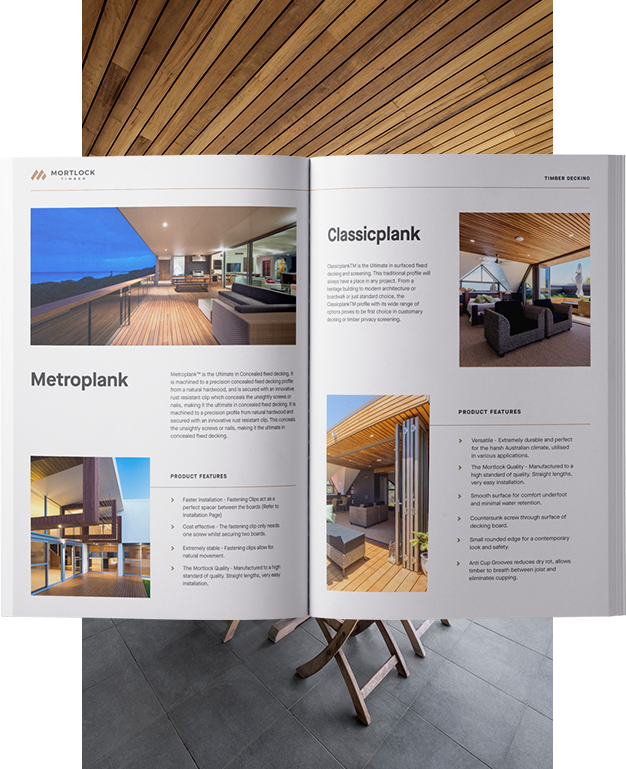
We are committed to bringing you timber products that add value and endure for years to come, even in heavy traffic and harsh weather conditions. We understand the value of efficiency when it comes to installation and keeping hardwood timber costs down. That’s why we’ve spent decades perfecting our designs to make them easier to handle, less wasteful and more efficient to install. This efficiency allows us to offer you premier products that are more cost-effective so that you can experience greater savings on timber wall costs, timber ceiling costs, timber cladding costs and timber decking costs.
Download our Pricing and Product Guide for our complete hardwood timber price list including timber decking prices, timber wall prices, timber ceiling prices and timber cladding prices.