
Timber Durability Classes Explained: Choosing the Right Timber for Your Project
Key take aways
With over 73,000 timber species worldwide and dozens routinely specified on Australian projects, selecting the right one can feel overwhelming. Janka ratings measure hardness. Hazard classes measure treatment levels. Stress grades measure structural capacity. And somewhere in the middle sits the classification that arguably matters most for longevity — yet is routinely misunderstood.
Timber durability class is the single most referenced metric when specifying timber for external applications in Australia. It determines how long a species resists decay and biological attack in its natural, untreated state. Get it right, and a deck or façade can outlast the mortgage. Get it wrong, and you may be replacing boards before the paint has faded on the front door.
The problem is that timber durability classes are often treated as a simple ranking — Class 1 good, Class 4 bad — when the reality is far more nuanced. A Class 1 Ironbark deck with poor drainage can fail faster than a well-detailed Class 2 Jarrah in the same climate. And a species that performs beautifully above ground may deteriorate within years in direct soil contact.
This guide breaks down what each class actually measures, how species perform across Australian conditions, and how to use this knowledge to make specification decisions that hold up on the building — not just on paper.

What is a timber durability class?
A timber durability class rates how heartwood resists fungal decay, termite attack, and lyctid borer damage without preservative treatment. In Australia, this durability classification system is governed by AS 5604:2022 and are based on small test specimens (35 × 35 mm above-ground, 50 × 50 mm in-ground), meaning larger construction members typically match or exceed rated performance.
Three critical points are often overlooked:
Heartwood only
All sapwood of all species — from the hardest Ironbark to the softest pine — is effectively Class 4 and will deteriorate rapidly unless treated or excluded.
Two separate ratings per species
AS 5604 provides distinct classifications for above-ground and in-ground use. Spotted Gum is Class 1 above ground but only Class 2 in ground — a distinction that changes specification decisions if missed.
Design is not included
Durability class does not account for detailing, finishes, or maintenance. A Class 1 timber trapping moisture can decay faster than a well-ventilated Class 2 application. Durability class should always sit within a broader framework — alongside profile design, fixing method, and maintenance planning.
How timber durability classes are used in practice
Durability classes provide the first filter in specification, establishing which species have the natural resistance to meet a given exposure condition. For external cladding on a coastal façade, a specifier would look to Class 1 or 2. For interior lining, Class 3 or 4 timbers become viable since moisture exposure is minimal.
But durability class is a starting point, not a conclusion. A Class 2 Jarrah deck with proper falls, subframe ventilation, stainless steel fixings, and maintained oil finish in suburban Melbourne can deliver 30+ years. A Class 1 Spotted Gum deck installed flat against a concrete slab with no drainage in a high-humidity zone may show decay within a decade, despite its higher classification. The difference is the system around the timber, not the timber itself.
The most effective approach is layered: species selection first (durability class), then design detailing (ventilation, drainage, orientation), then finish strategy, then fixing specification. Each layer compounds the performance of the one before it.

Timber durability classes explained
Service life ranges reflect expected heartwood performance under AS 5604:2022 with standard exposure and reasonable maintenance — not guarantees.
Class 1: Very high natural durability
Above-ground: 40+ years
In-ground: 25+ years
Common species: Spotted Gum (Janka 11.0 kN, density 950–1,010 kg/m³), Ironbark (Janka up to 14.0 kN, density 1,100+ kg/m³), Blackbutt (Janka 9.1 kN, density ~900 kg/m³)
These species contain dense, extractive-rich heartwood that actively resists fungal colonisation. Grey Ironbark is among the hardest commercial timbers on earth — so dense it will not float — and achieves Class 1 for both above-ground and in-ground, a distinction few species can claim.
Spotted Gum’s wavy interlocked grain produces the fiddleback figure sought by architects, and its low tannin leaching suits external cladding over light substrates. At the Dawesville House in coastal WA, it was specified for exactly this combination of resilience and visual warmth.
Blackbutt adds a key practical advantage: its heartwood is not susceptible to lyctid borer, unlike Spotted Gum and Jarrah. It also achieves BAL-29 under AS 3959, making it one of seven bushfire resisting timbers.
Best for: Decking in exposed conditions, external wall cladding and battens, screening, structural elements, and bushfire-prone areas.
Trade-offs: Requires pre-drilling, heavier on-site, and demands carbide-tipped tooling.
Systems like Trendplank are engineered for the substantial movement forces these timbers generate.
Class 2: High natural durability
Above-ground: 15–40 years
In-ground: 15–25 years
Common species: Jarrah (Janka 8.5 kN, density 835 kg/m³), Western Red Cedar (Janka ~1.6 kN, density 380 kg/m³), Pacific Teak
This class spans an unusually broad range. Jarrah, sourced exclusively from WA, delivers rich red-brown tones that deepen with age and an unusual property: natural marine borer resistance, making it exceptionally suited to coastal structures. At the Dawson Residence, Pacific Teak was selected for its longevity in harsh coastal conditions.
Western Red Cedar is often misclassified as Class 3, but carries a Class 2 above-ground rating per multiple Australian references. Performance is driven by natural extractives (thujaplicins) rather than density. Its dimensional stability and thermal insulation are exceptional, though its low density (380 kg/m³) makes it unsuitable for bushfire zones (minimum 680 kg/m³ required).
Best for: External cladding, residential decking, battens, screening, and feature elements.
Trade-offs: The wide 15–40 year range means maintenance quality has a proportionally larger impact on actual performance. Jarrah requires stainless steel fixings due to high tannin; WRC extractives corrode mild steel and aluminium.
Class 3: Moderate natural durability
Above-ground: 7–15 years
In-ground: 5–15 years
Common species: Tasmanian Oak (Janka 5.5–5.7 kN, density 650–780 kg/m³)
A frequently missed nuance: Tasmanian Oaks’ in-ground durability is actually Class 4 — it will deteriorate within 0–5 years in soil contact, despite performing adequately above ground for 7–15 years.
Its strength lies in workability. It machines, sands, and finishes far more easily than Class 1 hardwoods, and its pale straw to reddish-brown palette accepts stains exceptionally well — ideal for interior panelling, timber ceilings, flooring, and joinery.
Best for: Interior linings, feature walls, sheltered external elements with controlled moisture exposure.
Trade-offs: Not suitable for exposed external use. Susceptible to lyctid borer and not termite-resistant.
Class 4: Low natural durability
Above-ground: 0–7 years
In-ground: 0–5 years
Common species: Radiata Pine, Hoop Pine, Douglas Fir, and all sapwood of every species
Radiata Pine forms the backbone of Australian residential framing. Its value lies in consistency, availability, and suitability for preservative treatment — when treated to H3 or H4, Class 4 timbers deliver reliable performance at a fraction of hardwood cost.
Thermal modification offers an alternative path. Vacoa, a thermally modified Scandinavian pine, transforms from Class 4 into a viable external cladding and ceiling product. Malvec, heated to 230°C, achieves Class 1–2 durability with a 50+ year projected service life. And Shou Sugi Ban creates a 2–3 mm carbon layer delivering Class 1 durability at ~700 kg/m³.
Best for: Treated framing, interior joinery, and thermally modified variants for architectural cladding and ceilings.
Trade-offs: Untreated Class 4 should not be used in any exposed application. Treated pine introduces chemical considerations; thermally modified alternatives bridge the gap at a higher cost.

Timber durability class comparison
| Class 1 | Class 2 | Class 3 | Class 4 | |
| Above-ground life | 40+ years | 15–40 years | 7–15 years | 0–7 years |
| In-ground life | 25+ years | 15–25 years | 5–15 years | 0–5 years |
| Key species | Spotted Gum, Ironbark, Blackbutt | Jarrah, WR Cedar, Pacific Teak | Tasmanian Oak | Radiata Pine (treated), all sapwood |
| Janka range | 9.1–14.0 kN | 1.6–8.5 kN | 5.5–5.7 kN | Varies |
| Density range | 900–1,120 kg/m³ | 380–835 kg/m³ | 650–780 kg/m³ | Varies |
| Termite resistant | Yes (heartwood) | Yes (heartwood) | Generally no | No |
| BAL suitability | BAL-29+ | BAL-19 (varies) | Borderline BAL-19 | N/A |
| Pros | Maximum longevity; fire-compliant; termite resistant | Good durability-workability balance; strong aesthetics | Excellent workability; accepts finishes well; cost-effective indoors | Lowest cost; highly treatable; thermally modified variants available |
| Cons | Harder to machine; heavier; higher cost | Performance varies with maintenance; some high tannin | Not for exposed external use; limited termite resistance | No natural outdoor durability; needs treatment or modification |
| Best suited for | Maximum performance in exposed conditions | Balance of durability, aesthetics, and budget | Controlled interior environments | Budget projects with treatment/modification |
Data consolidated from AS 5604:2022, WoodSolutions, and Queensland Government (DAF) sources. Actual performance varies with detailing, climate, and maintenance.
Above-ground vs in-ground performance
One of the most consequential distinctions in timber specification — and one frequently missed — is the difference between above-ground and in-ground durability.
Above-ground timber goes through natural wetting and drying cycles. With adequate falls, ventilation, and drainage, moisture content regularly drops below the 20% threshold for fungal decay. In-ground timber sits in sustained moisture and microbial activity — above the 28% level where decay accelerates rapidly — with no drying cycle and no reprieve.
This is why Spotted Gum holds Class 1 above ground but only Class 2 in the ground, and why Tasmanian Oak drops from Class 3 to Class 4 in soil contact. For specifiers, the practical takeaway: always confirm both ratings for any species. A timber that excels as decking boards (above ground) may be unsuitable as deck posts (in-ground) without treatment. AS 5604 provides both figures for every listed species.
How Australian conditions affect timber durability
Durability class ratings are established under controlled test conditions. Australian building sites are anything but controlled — from tropical humidity in North Queensland to salt-laden coastal winds in Western Australia to alpine freeze-thaw cycles in Tasmania. Each environment places demands on timber that the durability class alone does not capture.
UV radiation
Australia’s intense UV attacks lignin, which absorbs 80–95% of UV energy, causing the familiar shift to silver-grey regardless of durability class. Only pigmented coatings provide lasting protection; clear finishes degrade quickly.
Coastal salt air
Salt is hygroscopic, drawing moisture into timber and creating decay-friendly conditions. At the Barwon Heads Residence, Blackbutt was specified for exactly this challenge. 316-grade stainless steel fixings are essential within 10 km of breaking surf per NCC.
Humidity and decay zones
Australia’s four decay hazard zones (A–D) range from arid interior to wet tropics. Climate research (Wang et al., 2012) projects decay rates could increase by ~10% in Brisbane and Sydney by 2080 — reinforcing the value of specifying conservatively for decking and cladding in coastal and subtropical zones.
Bushfire zones
Fire performance is driven by density, not durability class. Seven Bushfire Resisting Timbers are listed in AS 3959, including Blackbutt, Ironbark, and Spotted Gum. Minimum density: 680 kg/m³ for BAL-19, 750 kg/m³ for BAL-29. Western Red Cedar, despite being Class 2, has a density of just 380 kg/m³ — far below any BAL threshold. Always verify BAL compliance independently of durability class.

Which durability class is right for your project?
Rather than a hierarchy of “better” and “worse,” durability classes are most useful when matched to specific project conditions.
Class 1
Exposed external conditions where maximum service life is the priority. Unprotected decking, north- and west-facing cladding, coastal applications, commercial high-traffic areas, and bushfire zones. Class 1 is the default, where replacing timber is impractical or prohibitively expensive. The Kingswood Residence unified its entire exterior with Blackbutt across battens, cladding, and decking.
Class 2
Balance of durability, aesthetics, and workability. Residential decking, external features, battens, and applications where appearance matters as much as performance. Western Red Cedar excels for protected cladding where its stability and insulation add value. Class 2 also suits well-detailed external applications where the owner commits to regular maintenance.
Class 3
Controlled environments where exposure is limited or managed through design. Interior timber linings, ceilings, feature walls, joinery, and sheltered external elements. Tasmanian Oak’s neutral palette and workability make it a strong choice for interior fitouts where finish quality matters more than biological resistance.
Class 4 (treated/modified)
Budget efficiency. Treated pine framing remains the industry workhorse. For visible applications, Vacoa, Malvec, and Shou Sugi Ban elevate low-durability species into high-performance architectural products.
Durability class vs hazard class
This is one of the most common points of confusion in timber specification, and the distinction matters.
Durability class (AS 5604) measures the timber’s inherent, natural resistance — a material property. Hazard class (AS/NZS 1604) specifies the preservative treatment required for a given exposure environment:
H2: Framing (termite protection)
H3: External above-ground (decking joists, fascia, cladding)
H4: In-ground contact (fence posts, sleepers)
H5: In-ground structural (retaining walls, poles)
A Class 1 Spotted Gum deck board provides natural protection equivalent to H3 treatment — a key advantage where untreated aesthetics are preferred. However, even Class 1 species have Class 4 sapwood, and in areas with Mastotermes darwiniensis (giant northern termite), naturally resistant timber may still require supplementary management.
Specifying timber with confidence
Understanding timber durability class is the foundation of informed specification — but the foundation alone does not build the house. The difference between a timber installation that lasts 15 years and one that lasts 50 lies in the system: how species is matched to exposure, how detailing supports airflow and drainage, how fixings accommodate movement, and how maintenance is planned from the outset.
At Mortlock Timber, we work with architects and builders across Australia to align species selection with both design intent and long-term performance — from Class 1 hardwoods like Spotted Gum, Ironbark, and Blackbutt, to thermally modified products like Vacoa and Malvec.
Browse our portfolio for real-world examples, or get in touch to discuss your next project. Call 1800 058 420.
FAQS
Not necessarily. Durability class measures resistance to biological decay, not aesthetic weathering. A Class 1 Ironbark deck will silver off just as readily as a Class 2 Jarrah without a UV-protective finish. Higher durability provides longer structural service life, but finish maintenance remains a separate consideration.
No. Durability class (AS 5604) rates inherent heartwood resistance. Hazard class (AS/NZS 1604) specifies preservative treatment for a given exposure. A Class 1 hardwood may satisfy H3 performance intent without treatment; a Class 4 pine must be treated to meet the same requirement.
Significantly. UV degrades finishes regardless of class. Coastal salt air draws moisture into timber. High-humidity zones sustain decay-friendly conditions. Specifying one class above the minimum is common practice in coastal and subtropical regions.
Above-ground timber dries between wetting events; in-ground timber sits in sustained moisture. Spotted Gum is Class 1 above ground but Class 2 in-ground. Tasmanian Oak is Class 3 above ground but Class 4 in-ground. Always verify both ratings.
No. Blackbutt and Ironbark are both Class 1, but Ironbark is 50% harder (14.0 vs 9.1 kN Janka), denser, and achieves higher BAL ratings. Blackbutt is easier to work with and not susceptible to lyctid borer. Species selection within a class should consider the full picture.
Yes. Poor detailing — trapped moisture, inadequate ventilation, incorrect fixing — can override even Class 1 durability. Design detailing must always be considered alongside the durability class.
View our pricing and product guide
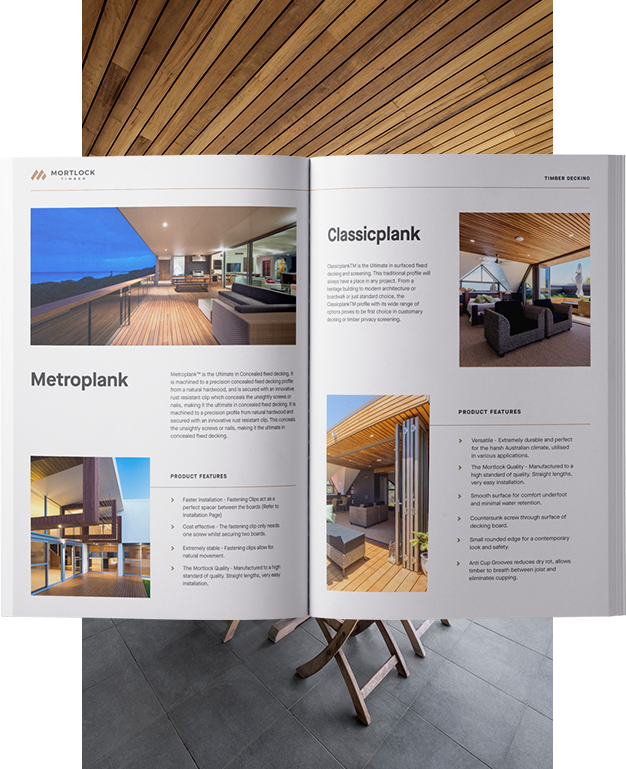
We are committed to bringing you timber products that add value and endure for years to come, even in heavy traffic and harsh weather conditions. We understand the value of efficiency when it comes to installation and keeping hardwood timber costs down. That’s why we’ve spent decades perfecting our designs to make them easier to handle, less wasteful and more efficient to install. This efficiency allows us to offer you premier products that are more cost-effective so that you can experience greater savings on timber wall costs, timber ceiling costs, timber cladding costs and timber decking costs.
Download our Pricing and Product Guide for our complete hardwood timber price list including timber decking prices, timber wall prices, timber ceiling prices and timber cladding prices.