
Hardwood vs Softwood: What’s the Difference?
Key take aways
Ask five people to explain hardwood vs softwood and you’ll usually get five different answers. Most involve the word “harder,” which can be where the confusion starts.
Hardwood and softwood don’t only relate to the “hardness” or “softness” of particular timber species. Each has its own set of characteristics and price points. The contrast between hardwood and softwood is important for the design as well as the building and maintenance phases of your project.
Hardwood and softwood are technical categories which include durability, fire performance, and how long a project holds its shape. By getting the terminology right, the specification decisions make a lot more sense.
What makes a timber a hardwood or softwood?
Hardwood and softwood are based on the tree, not the timber’s density or strength.
Hardwoods come from angiosperm trees: broadleaf, deciduous species like eucalypts, oaks, and teak. Their cellular structure includes vessels that carry water through the tree, which is part of why hardwood grain has a distinct texture.
Softwoods come from gymnosperm trees, conifers such as pine, fir, and cedar. These trees don’t produce vessels. Their structure is simpler and more uniform, which typically makes softwood easier to work with.
Although the names suggest a hardness comparison, that’s not what they measure. Balsa wood is technically a hardwood, and it’s one of the softest timbers. Douglas fir is a softwood that outperforms some hardwoods on structural strength. The species determines the category.
Australia’s building industry leans on native hardwoods. Common species include spotted gum, ironbark, blackbutt and jarrah, because our climate and bushfire regulations require density and durability. Softwood still has a place, particularly where cost efficiency or dimensional stability under thermal treatment outweighs raw density.
What is the Janka hardness rating?
Janka hardness measures the toughness of a timber sample. This is measured in kilonewtons (kN) and shows how timber can resist denting, scratching, and surface wear.
Australian native hardwoods tend to sit at the stronger end of the global scale.
| Species | Category | Janka hardness (kN) | Typical use |
| Ironbark | Hardwood | 14.0 | Structural decking, high-exposure cladding |
| Spotted gum | Hardwood | 11.0 | Cladding, decking, coastal and bushfire zones |
| Blackbutt | Hardwood | 9.1 | Cladding, decking, temperate zones |
| Jarrah | Hardwood | 8.5 | Decking, temperate applications |
| Cypress pine | Softwood | 6.1 | Building and heavy construction |
| Radiata pine | Softwood | 3.3 | Cladding, residential framing |
| Western red cedar | Softwood | ~1.6 | Feature cladding, low-traffic linings |
Janka Hardness (kN) are approximate measurements and can change based on age and growth environment.
Checking the Janka number is important as it can help with deciding the best timber to use for flooring, cladding or decking.
Hardwood vs softwood: strength, durability and cost
Strength, durability and cost don’t consistently move together, and this is where specification decisions can go wrong.
Strength
Strength is about the capacity the timber can hold and its resistance to bending or breaking. Usually, hardwoods are stronger, although softwoods, such as Cypress pine, are strong in structural framing.
Durability
Durability is governed in Australia by AS 5604:2022. This measures a timber species natural resistance to fungal decay and insect attacks. The ratings range from Class 1 (being the most durable) through to Class 4.
Timber species such as Ironbark, Blackbutt and Spotted Gum sit at Class 1. Jarrah, WR Cedar and Pacific Teak sit at Class 2, still strong but requiring more attention to detailing in high-moisture applications. Class 3 includes Tasmanian Oak, perfect for controlled interior environments. Untreated softwood will sit at Class 4, which is why almost all external softwood cladding has been treated.
Cost
Cost is where softwood has a competitive edge. Softwood is typically cheaper to source and process than slow-growing native hardwood. Softwood provides a lower material cost, but hardwood buys you untreated performance.
This is also where the cost conversation on hardwood vs softwood misleads people. A thermally modified softwood like Vacoa can outperform an untreated softwood on dimensional stability. It can’t replicate Class 1 hardwood in a bushfire zone, but with the right application, it can be a smart budget decision.
Examples of hardwood timber species
Australia’s hardwoods provide some of the most durable building materials. This is due to our native eucalypt species that were exposed to the elements and evolved in conditions demanding density and decay resistance.
Spotted Gum
Spotted gum is one of Australia’s premium native hardwoods. At 950 to 1,010 kg/m³, it handles coastal exposure, general bushfire zones, and a wide temperature range. We use it across cladding, decking, and Shou Sugi Ban charring projects.

Ironbark
Ironbark is native to New South Wales. At 1,100+ kg/m³, it’s one of the few species that carries a Class 1 durability rating above ground and in-ground. Ironbark’s tough exterior makes it the perfect choice for heavy-duty applications.
Jarrah
Jarrah is a slow-growing native to Western Australia. Its durability and warm red-to-blond colour set it apart from other hardwood species. It sits at Class 2 and remains a strong option for temperate decking and marine borer resistance.
Examples of softwood timber species
Softwood trees like pine trees grow faster than hardwood trees and are highly versatile, providing a completely different texture and feel.
Vacoa
Vacoa is a sustainable Nordic pine material produced in Europe. It is modified by a thermal heat and steam process which increases its durability. Vacoa Timber’s durability makes it a stable choice for exterior applications.
Cypress pine
Cypress pine is highly durable, stable, and rot-resistant timber, making it suitable for building and heavy construction. Although technically a softwood, many of its qualities reflect hardwood’s strength and durability.
Radiata pine
Radiata pine is a softwood that is fast-growing and is not suited to unprotected external use. Carpenters can easily work this timber as it has a straight grain and low natural durability.
Softwood species generally need either heavy protection, modification, or an interior application to perform near the level of an untreated durable hardwood.
What hardwood vs softwood means for your project
Different types of wood species can impact your specification documents. It’s important to make the right decision when choosing between hardwood vs softwood for your project.
BAL ratings
Compliance for external timber cladding and decking is assessed against Bushfire Attack Level (BAL) ratings. Timber cladding and decking with a density of at least 750 kg/m³ at 12% moisture content is accepted up to BAL-19. At the higher BAL-29 rating, compliance is achieved using a listed bushfire-resisting timber species.
Spotted gum, blackbutt, and ironbark are the species we specify into BAL-29 zones. No Mortlock product is rated for BAL-40 or BAL-FZ, which require non-combustible materials.
External vs internal
Externally, you’re managing UV, moisture cycling, and salt in coastal areas. That’s hardwood territory, or heavily modified softwood like Vacoa. Internally, a Class 2 or Class 3 timber performs well, opening up more softwood and lighter hardwood options, like Satinplank, for feature walls and ceilings.

Durability class in practice
A Class 1 hardwood on an exposed north-facing coastal facade might need recoating every 12 to 18 months and will still be standing decades later. A Class 4 untreated softwood in the same position could be showing decay within a few years. The class is the difference between a callback in year three and a maintenance conversation in year fifteen.
Talk to us about your next project
Getting the hardwood vs softwood decision right at the start saves a lot of rework later. Our team has walked architects, builders, and homeowners through this exact decision.
Every Mortlock product is manufactured to order for your specific project, not pulled from a warehouse shelf. We manufacture and pre-coat in our factory, then supply site-ready to projects across Australia. Once you’ve settled the hardwood vs softwood question, the next step is matching the right system to the application. Our Proplank click-in batten system works across interior and exterior walls and ceilings, while Trendplank concealed-fix cladding is engineered specifically for natural timber movement, with versatile applications.
Call us on 1800 058 420, get a quote, or download our Pricing and Product Guide to see species options, BAL ratings, and pricing.
FAQS
Not always. Hardwood is generally denser and more durable, but some softwoods are strong in structural applications. Strength, hardness, and durability are three separate measurements, and a timber can rank differently on each.
Under AS 3959:2018, external cladding and decking with a density of at least 750 kg/m³ at 12% moisture content, is accepted up to BAL-19. Standard softwoods don’t reach that threshold. Thermally modified softwoods like Vacoa aren’t rated for bushfire-prone applications in our range. For BAL-29 zones, you’re looking at spotted gum, blackbutt, or ironbark, which qualify as listed bushfire-resisting species.
Yes, you can. It’s common to see hardwood used externally for cladding or decking and a lighter softwood used for protected ceilings or feature walls indoors.
No. Janka hardness measures surface wear resistance, not bushfire compliance. BAL ratings under AS 3959 are based primarily on timber density and species listing. The two figures often move together in Australian hardwoods, but they’re not the same test and shouldn’t be treated as such.
View our pricing and product guide
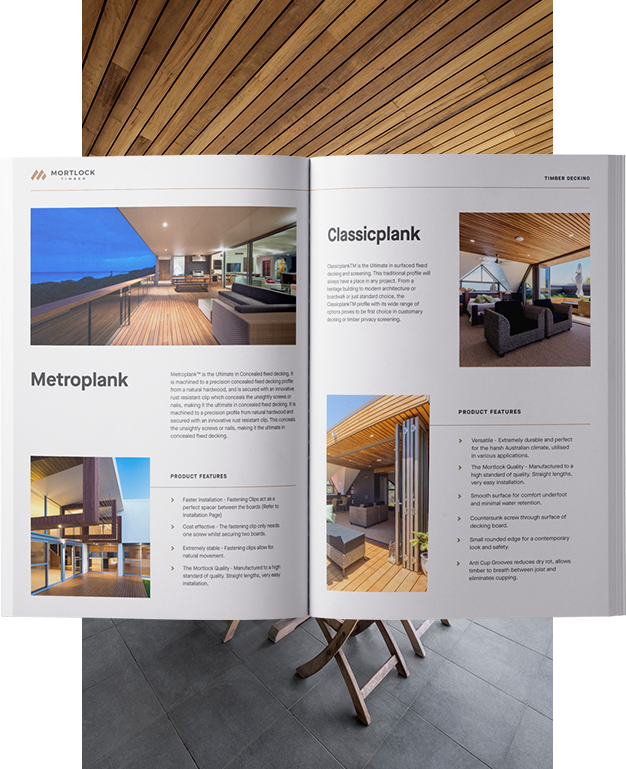
We are committed to bringing you timber products that add value and endure for years to come, even in heavy traffic and harsh weather conditions. We understand the value of efficiency when it comes to installation and keeping hardwood timber costs down. That’s why we’ve spent decades perfecting our designs to make them easier to handle, less wasteful and more efficient to install. This efficiency allows us to offer you premier products that are more cost-effective so that you can experience greater savings on timber wall costs, timber ceiling costs, timber cladding costs and timber decking costs.
Download our Pricing and Product Guide for our complete hardwood timber price list including timber decking prices, timber wall prices, timber ceiling prices and timber cladding prices.