
Iron Staining on Timber: Causes, Prevention and What To Do About It.
Key take aways
Iron Staining on Timber: Causes, Prevention and What to Do About It
If you’ve noticed blue-black or grey marks appearing on timber cladding or decking — often around fixings, or in patches after rain — you’re likely looking at iron staining. It’s one of the most common (and most avoidable) discolouration issues on site, and it catches out builders and installers more often than it should.
Here’s what causes it, how it differs from tannin leaching, and what you can do to avoid it on your next project.
What is iron staining?
Iron staining is a blue-black or grey discolouration that can appear on nearly all timber species. It’s caused by a chemical reaction between natural extractives in the wood and iron, most commonly from steel fasteners, fixings, chains or other metal fittings in contact with (or near) the timber.
The reaction typically needs moisture to occur. Rain or dew wets the timber surface, allowing the wood’s extractives and the iron to interact, which produces the dark discolouration. This is why iron staining often appears suddenly after wet weather, even on timber that looked fine when installed.
Iron staining is a surface reaction, not a structural issue. It doesn’t affect the strength or durability of the timber. But it’s visually obvious, and on a premium architectural project, it’s exactly the kind of defect a client or architect will flag at handover.
Iron staining vs tannin leaching: what’s the difference?
These two issues are often confused because they can look similar and both involve timber extractives, but they’re not the same thing.
- Tannin leaching happens when the timber’s own tannins are drawn out by moisture and carried onto adjacent surfaces — concrete, render, stone or paving — leaving brown streaking. It doesn’t require metal contact.
- Iron staining specifically requires iron (or iron-contaminated dust or residue) to be present, in contact with or very close to the timber. The result is a blue-black or grey mark, usually localised around the source of contamination.
Mortlock Timber has a separate technical page on tannin leaching, including how to minimise it: Timber Leaching Guide. If your issue looks like brown staining running onto a nearby surface rather than dark marks on the timber itself, that’s the more relevant read.


What causes iron staining on site
Iron staining is almost always a site-handling or specification issue rather than a fault in the timber itself. The most common causes are:
1. Grinding, cutting and metal fragment contamination
Iron stains are frequently linked to trace iron left behind from:
- Cutting or welding fragments landing on or near stacked timber
- Cleaning timber surfaces with steel wool or wire brushes
- Iron dust from nearby metalworking or grinding
- Contamination from fertilisers or other iron-containing products stored nearby
Timber on site should be kept well away from these contamination sources, and stored under cover — protected with a tarp and out of the rain — until it’s ready for installation. Once rain reaches contaminated timber, the reaction can start.
2. Poor-quality fixings
Rust and stripped or degraded metal filings from lower-grade fixings can chemically react with the timber. This usually shows up as dark staining localised around the fixing point, generally affecting only the surface layer.
This is the easiest cause to design out. Using genuine stainless steel fixings, rather than mild steel, galvanised, or lower-grade fixings that will corrode over time, significantly reduces the risk of contamination at the fixing point.
How to reduce the risk of iron staining
Most iron staining is preventable with reasonable site practices and the right fixing specification.
On site:
- Store timber under cover and off the ground before installation
- Keep timber away from grinding, welding, cutting or fabrication work
- Avoid cleaning timber with steel wool or wire brushes
- Keep timber away from stored fertilisers or other iron-based products
- Handle pre-finished or pre-coated boards carefully to avoid introducing metal contaminants to the surface
In your fixing specification:
- Specify genuine stainless steel fixings rather than mild steel or galvanised alternatives
- Match the fixing grade to the exposure — Mortlock Timber’s cladding systems, including Trendplank and Shou Sugi Ban, use A2 304 stainless steel SPAX façade screws as standard
- For coastal or high-exposure environments, a higher-grade stainless fixing (such as 316) may be appropriate — confirm exposure classification and fixing requirements with your project team or Mortlock Timber before ordering
- Avoid mixing incompatible metals in fixings, flashings and brackets in the same assembly

If iron staining has already occurred
Because iron staining is a surface-level reaction, it’s usually confined to the affected area rather than indicating a wider problem with the timber. That said, treatment depends on the coating system (if any) already applied to the timber, and harsh cleaning products can damage factory-applied finishes.
As a starting point:
- Identify and remove the source of contamination first — there’s no point treating a stain that’s still being fed by a rusting fixing or nearby metal fragment
- Check the maintenance guidance for the specific coating system on your timber before applying any cleaning product — Mortlock Timber’s maintenance sheets for Cutek CD50, WOCA, SiOO:X and other systems specifically advise against solvent-based or abrasive cleaners
- For coated or pre-finished timber, contact Mortlock Timber before attempting to treat a stain, so the approach doesn’t void the finish or void a warranty condition
- For unfinished or raw timber, a specialist wood-cleaning product may help lighten iron staining, but this should be tested on an inconspicuous area first and confirmed as suitable for the specific species and finish
A note on timber species
Iron stain can occur on nearly all timber species, so this isn’t a reason to avoid a particular species. Timbers naturally higher in extractives — which includes many Australian hardwoods used in architectural cladding and decking — may show the reaction more visibly when it does occur, simply because there’s more extractive content available to react with the iron. This is a general principle rather than a specific claim about any one Mortlock Timber species, and species-specific guidance should be confirmed with Mortlock Timber’s technical team if it’s a concern for your project.
The bottom line
Iron staining is a site-management and specification issue, not a reason to question timber as a material. Keep timber clean and covered before installation, keep it away from metal contamination sources, and specify genuine stainless steel fixings matched to your exposure conditions. Do that consistently, and iron staining is largely designed out of the project before it becomes a problem.
If you’re finalising a fixing specification or want to confirm the right coating and fixing combination for your project’s exposure conditions, our team can help.
Speak with our team on 1800 058 420 or request a quote online. For product specifications and pricing, download our Pricing and Product Guide.
FAQS
No. Iron staining is a surface-level chemical reaction between extractives and iron. It doesn’t compromise the timber’s strength or durability, though it can be a visible aesthetic issue on an otherwise well-finished project.
This depends on the cause and the specific product involved. Staining caused by site contamination or non-approved fixings is generally a handling or specification issue rather than a timber or coating fault. Confirm warranty conditions with Mortlock Timber before making any claim.
Sometimes, depending on the timber, whether it’s coated, and how long the staining has been present. Always identify and remove the source of contamination first, and check the maintenance guidance for the specific coating system before applying any cleaning product — solvent-based or abrasive cleaners can damage factory-applied finishes. For a confirmed treatment method, speak with Mortlock Timber directly.
Mortlock Timber’s cladding systems, including Trendplank and Shou Sugi Ban, use A2 304 stainless steel SPAX façade screws as standard. For coastal or high-exposure sites, a higher-grade stainless fixing may be more appropriate. Confirm the right fixing grade for your project’s exposure with Mortlock Timber before ordering.
No. Iron staining can occur on nearly all timber species, so it isn’t a reason to avoid a particular species. It’s more accurately addressed through site handling practices and fixing specification than through species selection.
View our pricing and product guide
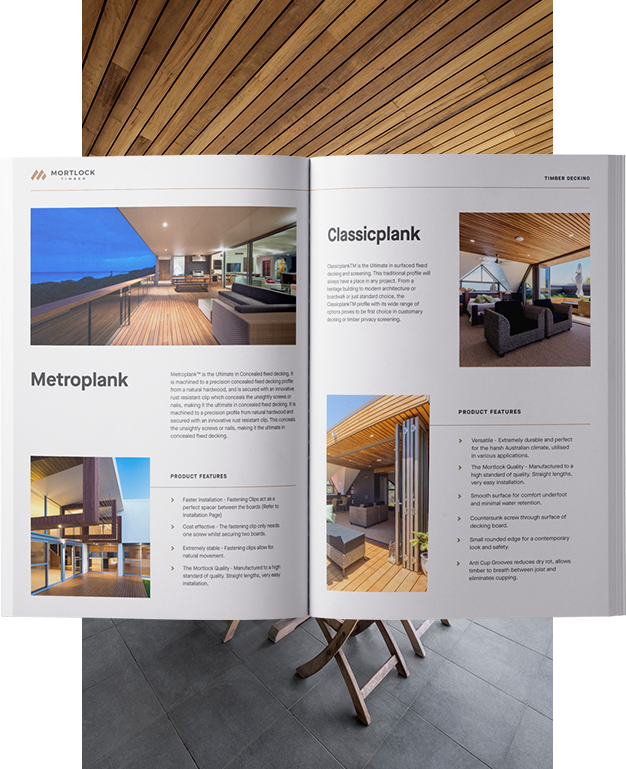
We are committed to bringing you timber products that add value and endure for years to come, even in heavy traffic and harsh weather conditions. We understand the value of efficiency when it comes to installation and keeping hardwood timber costs down. That’s why we’ve spent decades perfecting our designs to make them easier to handle, less wasteful and more efficient to install. This efficiency allows us to offer you premier products that are more cost-effective so that you can experience greater savings on timber wall costs, timber ceiling costs, timber cladding costs and timber decking costs.
Download our Pricing and Product Guide for our complete hardwood timber price list including timber decking prices, timber wall prices, timber ceiling prices and timber cladding prices.